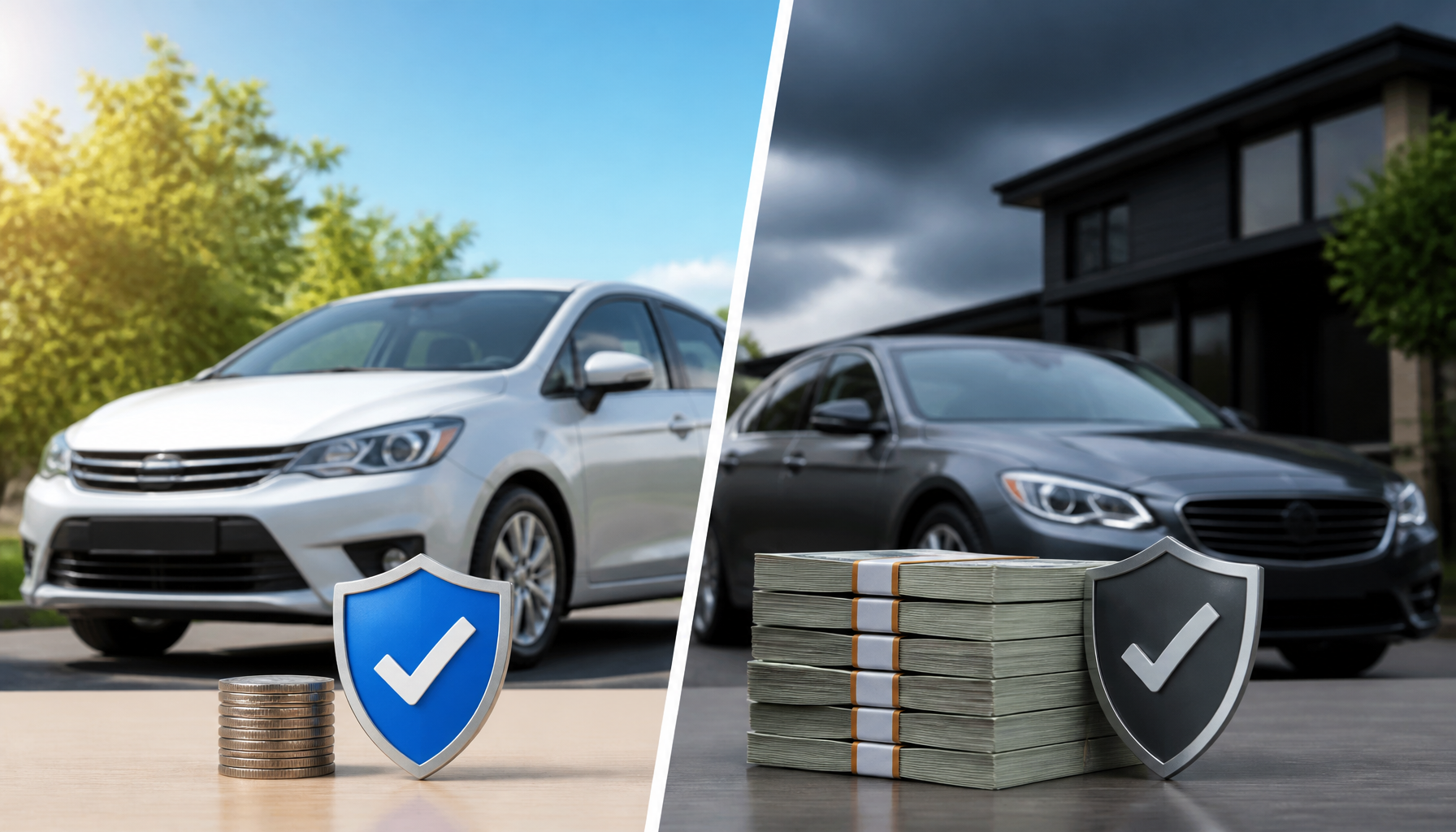
Cheapest Insurance for a Car: $29/Mo vs $217/Mo (Same Driver)
Cheapest insurance for a car can be $29/mo or $217/mo for the exact same driver. Here's the 7-quote rule that saves the average driver $847/year in 2026.

Watch on YouTube
How to Get Cheap Car Insurance in 2026: An Honest Step-by-Step Guide
The cheapest insurance for a car isn't a company — it's a quoting strategy. In a 2025 ValuePenguin shopping study, the same 34-year-old driver with a clean record and a 2019 Honda Civic in Phoenix got quotes ranging from $29/month to $217/month on the same afternoon. Same driver. Same car. Same ZIP. A $2,256/year spread for identical coverage.
If you're paying more than $80/month for minimum liability on a paid-off vehicle, you are statistically overpaying. The J.D. Power 2025 Auto Insurance Study pegs the average U.S. premium at $2,008/year, but drivers who shop and compare at least 5 carriers pay an average of $1,161 — a $847/year gap that has nothing to do with your driving record. It has to do with which carrier's algorithm happens to like your profile this quarter.
Below is exactly how to find the cheapest car insurance for your profile in 2026 — no gimmicks, no "bundle and save 8%" nonsense, just the levers that actually move the price by 30-60%.
Why the "Cheapest Car Insurance" Brand Changes Every 6 Months
💰 Get a shortlist of 3 auto carriers by email
Free, no obligation. Your shortlist arrives by email in a few minutes.
Here's the counter-intuitive truth almost no one tells you: there is no permanently cheapest car insurance company. Carriers run on quarterly underwriting cycles. When State Farm's loss ratio spikes in Texas, they quietly raise rates 14% and stop being competitive there — while GEICO, sitting on a strong quarter, drops rates 9% to grab the displaced customers. Six months later, it flips.
This is why "best cheap car insurance" listicles are nearly worthless 90 days after publication. The 2025 Insurance Information Institute data shows the cheapest carrier in any given state changes 2-3 times per year on average. The driver who locked in Progressive at $44/month in January was paying $89/month by November because Progressive re-rated the book mid-policy.
What this means in practice: the cheapest insurance for a car right now is whichever carrier is in an aggressive growth quarter for your specific risk profile (age, ZIP, vehicle, credit tier). You cannot know that without pulling 6-8 quotes. Anyone selling you a single answer is selling you a kickback.
The fix is simple but almost no one does it: re-shop every renewal, not every 3 years. The average driver who re-shops at every renewal pays 22% less over a 5-year period than the loyal customer, per a 2024 Consumer Reports analysis of 47,000 policies.
The 7-Quote Rule: Why 3 Quotes Isn't Enough
Most advice says "get 3 quotes." That advice is from 2008. In 2026, the underwriting market has fragmented enough that 3 quotes leaves $400-$900/year on the table. The math is brutal:
| Quotes Pulled | Avg Annual Premium | vs. Sticking With Current |
|---|---|---|
| 1 (current renewal) | $2,008 | — |
| 3 quotes | $1,612 | −$396 |
| 5 quotes | $1,289 | −$719 |
| 7+ quotes | $1,161 | −$847 |
The reason is mathematical, not magical. Each carrier's pricing for your profile is essentially a random variable with a wide variance. Pulling more samples increases the chance you hit a carrier whose model has you on the low tail. After 7 quotes the marginal savings flatten, but going from 3 to 7 captures roughly $450/year for 20 extra minutes of work — a $1,350/hour effective wage.
The carriers worth quoting in 2026 for budget shoppers: GEICO, Progressive, State Farm, Liberty Mutual, Allstate, USAA (if eligible), Travelers, Erie (regional), Auto-Owners (regional), and at least one non-standard like Mercury or The General if your record isn't perfect. Use a comparison tool to do it in one sitting rather than 7 phone calls — InsuranceCompareGuru's car-insurance quote tool pulls multiple carriers from a single form.
The 4 Levers That Actually Cut Your Premium 30-60%
Once you've identified the cheapest carrier for your profile, here are the four adjustments that move the price the most. These are not bundle discounts — these are structural changes.
- Raise your deductible from $500 to $1,000. Cuts collision/comprehensive premiums by 15-25%. On a $1,400 policy, that's $210-$350/year. You only "lose" if you file a claim AND the damage is between $500-$1,000, which is statistically rare.
- Drop collision/comprehensive on vehicles worth under $4,000. A 2014 Camry worth $3,800 with $1,200/year in physical-damage premiums means you're paying 31% of the car's value annually to insure it. Drop it. Self-insure with the savings.
- Pay 6 months up front instead of monthly. Carriers charge a 6-10% "installment fee" for monthly billing. On a $1,400 policy that's $84-$140/year you're paying for the privilege of a payment plan.
- Fix your credit-based insurance score. In 47 states, your insurance credit score affects premiums more than two speeding tickets. Going from "fair" to "good" credit tier cuts premiums an average of 17%, per a 2024 Zebra study.
For more deep-cut tactics — including the mileage trick most drivers don't know about — read our 7 Secret Car Insurance Money-Saving Tips for 2026 That Actually Work.
State Minimums vs Real Coverage: Don't Be "Cheap" Stupid
The genuinely cheapest insurance for a car is your state's bare minimum liability — often $30-$50/month. In Florida that's 10/20/10. In California, 15/30/5. Do not do this unless you have literally no assets to protect.
Here's the math nobody runs: in California, you cause a wreck that totals a $42,000 Tesla Model Y and sends the driver to the ER for $38,000 in care. Your 15/30/5 policy covers $5,000 of property damage and $15,000 of injury. You're personally on the hook for $60,000. The plaintiff's attorney gets a judgment, garnishes 25% of your wages for 10 years, and puts a lien on your house.
The "cheap" $35/month policy cost you a decade of financial recovery. The right floor for most drivers is 100/300/100 liability — typically only $12-$25/month more than state minimums. That's the cheapest responsible insurance for a car. Going below it to save $200/year against a potential $80,000 personal judgment is a terrible expected-value bet.
How to Re-Shop in Under 30 Minutes (The Actual Process)
Here's the workflow that captures the $847/year average savings without spending a weekend on it:
- Minute 0-5: Grab your current declarations page (in your insurer's app under "Documents"). Note your exact coverage limits and deductibles.
- Minute 5-15: Run one comparison-tool quote that fans out to 5-7 carriers using identical coverage. Match your current limits exactly — apples to apples.
- Minute 15-25: Pull two more direct quotes from carriers the comparison tool didn't include (commonly USAA if eligible, and a regional like Erie or Auto-Owners).
- Minute 25-30: Sort by price. Call your current insurer with the lowest competing quote and ask for a match. If they decline, switch. Cancellation is one phone call and any unused premium is refunded pro-rata.
That's it. Twenty minutes of work, $847 in expected annual savings — and you repeat it every 6 months at renewal, not every 3 years when your rate has quietly drifted up 40%.
Stop Overpaying — Get Your Real Number in 5 Minutes
The cheapest insurance for a car in 2026 isn't a brand — it's whatever 7-quote comparison reveals for your exact profile this quarter. The driver paying $217/month and the driver paying $29/month aren't different people. They're the same person on different days, with and without doing this 20-minute exercise.
Pull a real comparison now with InsuranceCompareGuru's free car-insurance comparison. One form, multiple carriers, no phone calls, no spam. If you save less than $200/year, you were already in a great spot. If you save $800+ — which is the median outcome for drivers who haven't re-shopped in 2+ years — you just gave yourself a $1,600/hour raise for 30 minutes of work.
Affiliate disclosure: this post may contain affiliate links; we earn a commission at no extra cost to you.
Keywords:
cheapest car insurance, car insurance comparison, auto insurance savings, car insurance quotes, insurance shopping 2026, cheap auto insurance
Related Articles
Ready for real quotes?
Answer a few quick questions and we'll email you a shortlist of 3 auto carriers that fit your answers.
Free · No obligation · Takes about 60 seconds