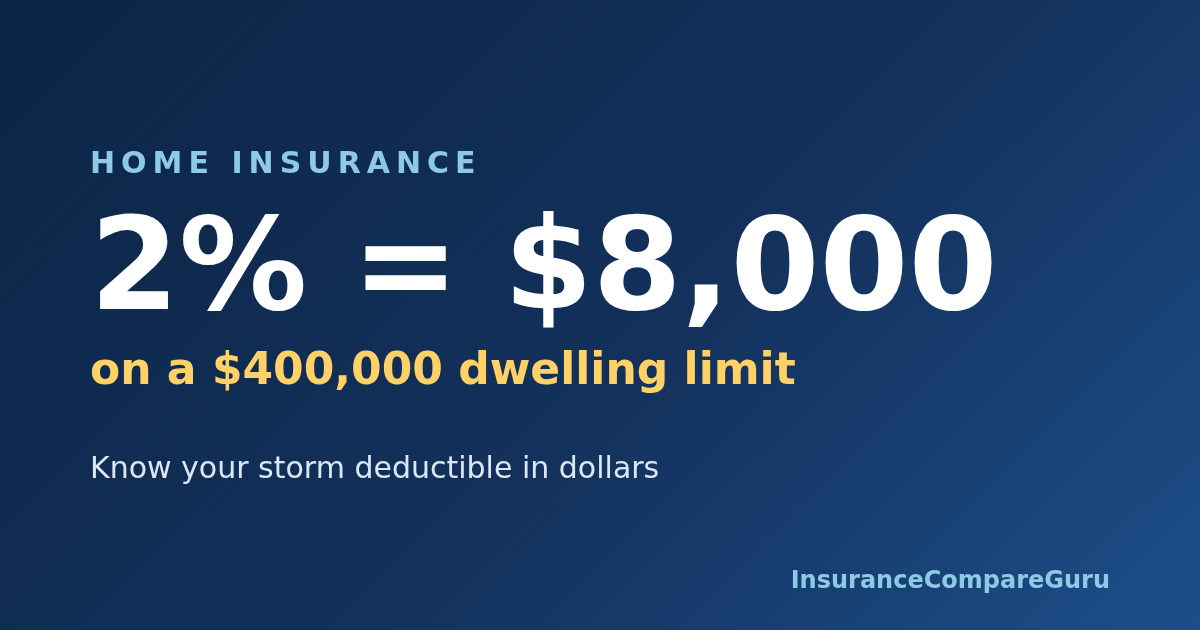
Homeowners Insurance Deductible: Why 2% Can Mean $8,000
Homeowners insurance deductible math: a 2% hurricane deductible on a $400K home is $8,000. Find yours, check the trigger, and run the break-even.

Watch on YouTube
How to Get Renters Insurance Quotes in 2026: Honest Step-by-Step
Most homeowners can tell you their deductible is $1,000. Far fewer know that their policy may have a second deductible for wind or hurricanes that isn't a dollar amount at all. It's a percentage of your dwelling coverage. On a home insured for $400,000, a 2% hurricane deductible means you pay the first $8,000 of storm damage yourself, not $1,000.
People usually find this out after the storm, while reading a claim letter. This article shows how percentage deductibles work, how to find yours on your declarations page, and how to work out whether a lower one is worth the higher premium before hurricane or hail season starts again.
Flat vs percentage homeowners insurance deductibles
🏠 Get a shortlist of 3 home carriers by email
Free, no obligation. Your shortlist arrives by email in a few minutes.
A standard homeowners policy can carry two kinds of deductible:
- Flat (all-other-perils) deductible. A fixed dollar amount, such as $500, $1,000 or $2,500. It applies to fire, theft, burst pipes and most other covered losses.
- Percentage deductible. A percentage of your dwelling coverage limit (Coverage A on your declarations page), not of the claim and not of your home's market value. Insurers use these for hurricane, named-storm, windstorm or wind/hail damage, and earthquake policies use them too.
According to the Insurance Information Institute's background on hurricane and windstorm deductibles, percentage deductibles typically run from 1% to 5% of a home's insured value and can go higher in high-risk coastal areas. In some of those areas, the percentage deductible is mandatory and you can't buy your way back to a flat dollar amount.
What 1%, 2% and 5% actually cost you
| Dwelling coverage (Coverage A) | 1% deductible | 2% deductible | 5% deductible |
|---|---|---|---|
| $250,000 | $2,500 | $5,000 | $12,500 |
| $400,000 | $4,000 | $8,000 | $20,000 |
| $600,000 | $6,000 | $12,000 | $30,000 |
Now apply it to a real-looking claim. A storm tears up part of your roof and lets water into a bedroom. The repair estimate is $14,000 on a home with $400,000 of dwelling coverage:
- With a $1,000 flat deductible, the insurer pays $13,000.
- With a 2% hurricane deductible ($8,000), the insurer pays $6,000.
- With a 5% hurricane deductible ($20,000), the insurer pays nothing. The whole repair is on you.
Same house, same storm, same roof. The only difference is one line on the declarations page.
Where these deductibles apply
The III reports that 19 states and the District of Columbia have hurricane deductibles: Alabama, Connecticut, Delaware, Florida, Georgia, Hawaii, Louisiana, Maine, Maryland, Massachusetts, Mississippi, New Jersey, New York, North Carolina, Pennsylvania, Rhode Island, South Carolina, Texas and Virginia, plus Washington, D.C.
Wind/hail percentage deductibles are a separate issue. They're common in hail-prone states, including much of the Plains and Mountain West, and they apply to any wind or hail damage, not just hurricanes. A spring hailstorm in Colorado or Texas can trigger a percentage deductible just as easily as a hurricane does on the coast.
Earthquake coverage follows the same pattern, usually with higher percentages. If you're in California, our article on earthquake insurance in California covers how those deductibles change the math.
What triggers a hurricane deductible
A hurricane deductible only applies when the storm meets the "trigger" in your policy. Triggers vary by state and insurer. They may depend on the National Weather Service naming a tropical storm, issuing a hurricane watch or warning, or rating a storm's intensity. Most include a time window before and after the storm.
Florida sets the rules by law. Its hurricane deductible applies to hurricane damage from the time a hurricane watch or warning is issued for any part of the state until 72 hours after it ends. It applies once per hurricane season, not once per storm. Florida insurers must offer hurricane deductible options of $500, 2%, 5% and 10% of dwelling limits, per the III summary.
Two practical takeaways:
- A storm that never becomes a hurricane may fall under your flat deductible instead, or under a separate wind/hail deductible if you have one.
- Outside Florida, ask whether your hurricane deductible applies per storm or per season. Two storms in one year could mean paying it twice.
The mistake that grows your deductible every year
Many policies include an "inflation guard" that raises your dwelling coverage at each renewal to keep up with construction costs. That protects you from being underinsured. It also quietly raises every percentage deductible tied to that limit.
If your Coverage A rises from $400,000 to $440,000 over a few renewals, your 2% hurricane deductible goes from $8,000 to $8,800. You didn't choose a higher deductible, and nobody sent a letter about it. Re-read the deductible lines every renewal, not just the premium.
The fix is not to cut your dwelling coverage to shrink the deductible. Being underinsured on a total loss costs far more. For how to set that limit, see what homeowners insurance covers, with a $250K example.
How to find your deductible in five minutes
- Open your declarations page (usually page one or two of your policy, or in your insurer's app).
- Find the "Deductibles" section. Look for more than one line, such as "All Other Perils," "Hurricane," "Named Storm," "Windstorm or Hail" or "Wind/Hail."
- If a line shows a percentage, multiply it by your Coverage A (dwelling) limit. That's your real out-of-pocket amount for that kind of storm.
- Check the trigger and whether it applies per storm or per season. It's in the policy's deductible endorsement.
- Write the dollar number down somewhere you'll see it when you set your emergency savings goal.
Should you pay more for a lower deductible?
Ask your agent or carrier to quote the same policy at two or three deductible levels, for example 1%, 2% and 5%. Then run this math:
- Extra exposure: the dollar difference between the two deductibles. On a $400,000 home, going from 2% to 5% adds $12,000 of risk.
- Annual savings: the premium difference between the two quotes.
- Break-even years: extra exposure ÷ annual savings. If you'd save $600 a year by taking on $12,000 more risk, it takes 20 storm-free years to come out ahead.
A higher deductible usually makes sense only when you could pay it from savings without borrowing and your area rarely sees damaging storms. If one bad storm would push the repair onto a credit card, the lower deductible is usually worth the premium. Also ask about wind mitigation credits. Roof straps, impact-rated windows and fortified roofs often earn discounts, and Florida requires insurers to offer mitigation credits. More ways to cut premium without raising risk are in our guide to saving money on homeowners insurance.
What a percentage deductible won't cover anyway
Even after you pay the deductible, standard homeowners policies don't cover flood damage, and that includes storm surge from a hurricane. Wind that rips off the roof is a homeowners claim. Water that rises from the street is a flood claim, which needs a separate policy. See flood insurance vs homeowners insurance for how the two fit together, and the coverage gaps most homeowners miss for the other common surprises.
Checklist before the next storm season
- Know every deductible on your policy in dollars, not percentages.
- Confirm the hurricane trigger and whether it's per storm or per season.
- Re-check the numbers each renewal, since inflation guard raises them.
- Get quotes at two or three deductible levels and run the break-even math.
- Keep emergency savings at least equal to your largest deductible.
- Decide on flood coverage separately. It isn't part of the deductible question.
Carriers price percentage deductibles very differently, and some offer flat options where others don't. Compare homeowners insurance quotes on InsuranceCompareGuru and match the deductible lines, not just the premium, before you switch.
This article is general information, not legal or insurance advice. Deductible rules, triggers and options vary by state and insurer. Check your policy and your state insurance department for the rules that apply to you.
Affiliate disclosure: this post may contain affiliate links; we earn a commission at no extra cost to you.
Keywords:
homeowners insurance deductible, hurricane deductible, percentage deductible, wind hail deductible, home insurance deductible, named storm deductible
Related Articles
Get real homeowners quotes
Answer a few questions and we'll email you a shortlist of 3 home insurers that fit your answers.
Free · No obligation · Takes about 60 seconds