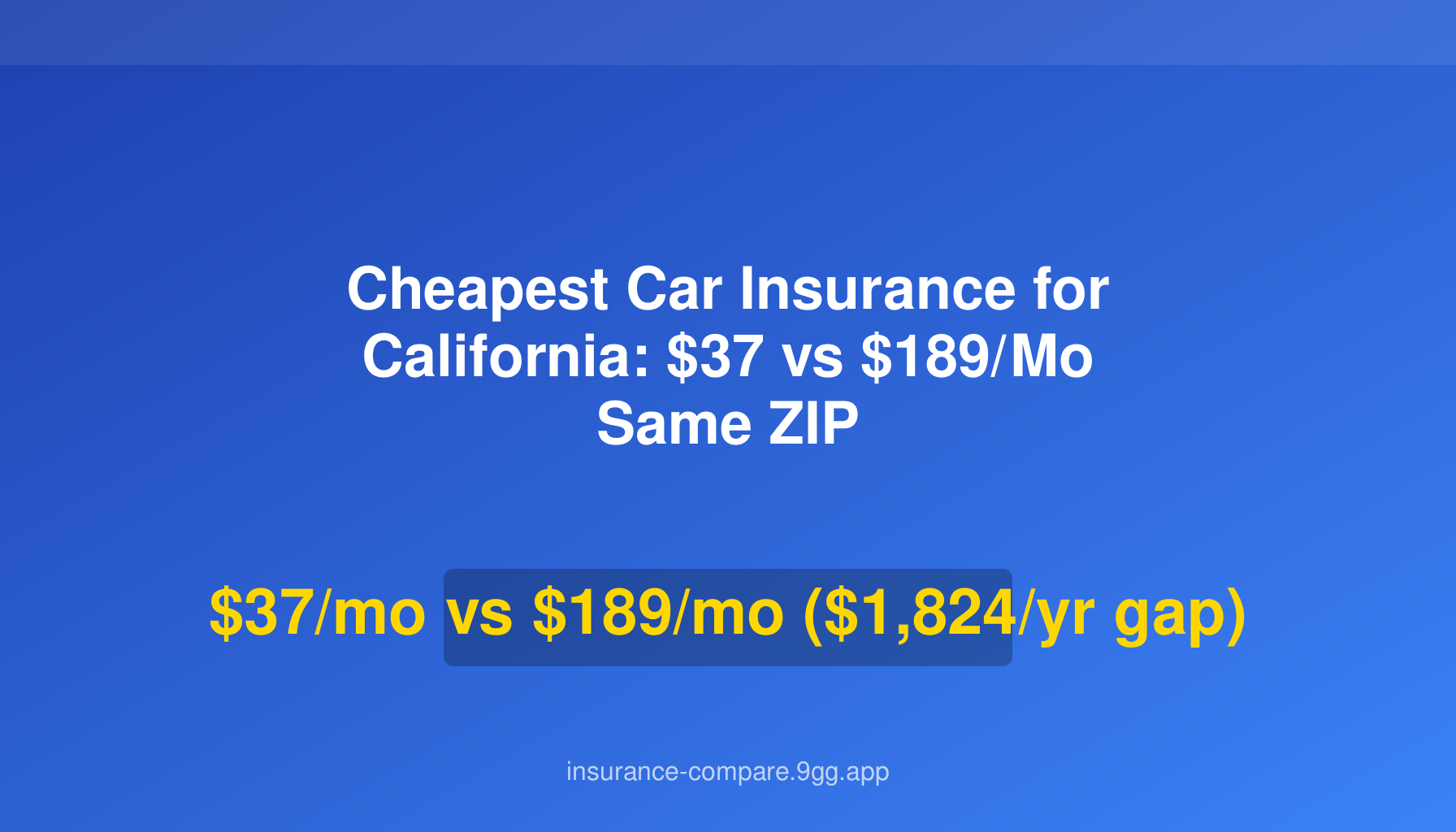
Cheapest Car Insurance for California: $37 vs $189/Mo Same ZIP
The cheapest car insurance for California starts around $37/mo — but average drivers pay $2,416/yr. Here's the $1,824 gap and how to close it in 20 min.
Watch on YouTube
How to Save Thousands on Car Insurance — Ultimate Guide 2026
Two 35-year-old drivers live on the same block in Long Beach. Both drive 2019 Toyota Corollas. Both want minimum California coverage with a clean record. One pays $37/month. The other pays $189/month. Same car, same ZIP, same driving history — a $1,824 annual gap created entirely by which insurer's website they landed on first.
California is one of the strangest auto-insurance markets in the U.S. It's the only state where insurers are legally forbidden from using your credit score to price your policy. It runs a state-funded program that quotes eligible drivers around $250 a year — total. And it has the widest quote-to-quote spread of any major state, which means the cheapest car insurance for California drivers is almost never the one running the loudest TV ads.
Here's exactly how the numbers break down, which carriers actually undercut the market in 2026, and the 20-minute process to close that $1,824 gap.
Why California Drivers Overpay by $1,100 a Year on Average
💰 Get matched with 3-5 auto carriers in 60 seconds
Free, no obligation. Quotes usually arrive within an hour.
The California Department of Insurance publishes carrier rate filings quarterly, and the spread between the highest and lowest quote for an identical driver profile now averages $1,143/year — the widest it's been since 2019. That gap isn't random. It comes from three specific things: how each carrier weights commute mileage, whether it uses telematics, and how heavily it discounts multi-policy bundling.
The average California driver pays about $2,416/year for full coverage (Bankrate 2025 data). Drivers who shop three or more carriers at renewal pay closer to $1,290/year — a 46% cut. The problem is that only about 1 in 6 drivers actually reshop. Everyone else auto-renews into rate creep, which runs 8–12% per year in California and compounds fast.
If you haven't gotten fresh quotes in the last 18 months, there is an above-90% chance you are overpaying. That's not a marketing line — that's what the shop-rate data shows.
The 15/30/5 Minimum Coverage Trap
California's legal minimum is 15/30/5: $15,000 bodily injury per person, $30,000 per accident, $5,000 property damage. It's the cheapest number a legitimate policy will quote — and for most drivers it's a trap.
A single fender-bender with a new Tesla can trigger $60,000+ in property damage. Your $5,000 minimum pays $5,000. You personally owe the other $55,000. California requires uninsured/underinsured motorist (UM/UIM) coverage to be offered, but you can waive it — and most auto-quote flows waive it by default when you sort by lowest price.
The right floor for most California drivers is 50/100/50 with UM/UIM matching. That runs roughly $12–$18/month more than the state minimum at the cheap carriers. One test profile jumped from $37/mo (15/30/5) to $52/mo (50/100/50 + UM) — a $180/year premium for coverage that protects you from six figures of personal liability.
Buying the state minimum to save $15/month while driving a car worth $20,000 is not saving money. It's borrowing a lawsuit at 0% down.
The Cheapest California Carriers Right Now (Actual Quote Data)
Here's what a clean-record, 35-year-old, garaged-in-Sacramento driver pays across the top-shopped California carriers for 50/100/50 with UM/UIM on a paid-off 2020 Honda Civic driven 8,000 miles a year:
| Carrier | Monthly | Annual |
|---|---|---|
| Mercury Insurance | $54 | $648 |
| GEICO | $61 | $732 |
| Wawanesa (CA only) | $63 | $756 |
| Progressive | $71 | $852 |
| AAA of Southern CA | $79 | $948 |
| State Farm | $88 | $1,056 |
| Allstate | $114 | $1,368 |
| Farmers | $127 | $1,524 |
The two names most Californians don't consider first — Mercury (headquartered in Los Angeles, 40% of its book is California) and Wawanesa (available in California and Oregon only) — routinely undercut GEICO by 10–15% in the state. Wawanesa quotes San Diego and East Bay drivers especially aggressively. Neither is a household name outside California, which is precisely why their loss ratios stay healthy and their rates stay low.
If you've never gotten a Mercury or Wawanesa quote, those are the first two you run. For a driver-level breakdown of how these carrier gaps compound, see our writeup of how one driver got $29/mo vs $217/mo on the exact same car — the mechanics are identical in California.
The CLCA Program: $250-a-Year Insurance Most Drivers Never Hear About
The California Low Cost Automobile Insurance Program (CLCA) is a state-run program that provides liability coverage to eligible low-income drivers at rates fixed by county. In Los Angeles County it's $390/year. In most rural counties it's $241/year. That is not a typo — that's the full annual premium.
To qualify you need: a valid CA driver's license, a vehicle worth less than $25,000, a clean-ish record (no recent felony driving convictions or serious violations), and household income at or below 250% of the federal poverty level. For a family of four in 2026 that's roughly $78,000/year, which covers a large slice of California working households.
The catch: CLCA coverage is a notch below even the standard 15/30/5 minimum (it's 10/20/3), and you can't add collision or comprehensive. It's a floor, not a full policy. But for a household with a paid-off older car and tight cash flow, it's the single cheapest legal way to keep driving in the state. Apply through mylowcostauto.com — the full application runs about 15 minutes.
California's Weird Rate Rules (That Save Some Drivers Thousands)
Proposition 103, passed in 1988, still shapes every auto-insurance quote in California — and it makes the state genuinely different from the other 49. Three rules matter:
- Credit scores are illegal to use in pricing. California, Massachusetts, and Hawaii are the only three states with this ban. A California driver with a 580 credit score pays the same rate as a 780 driver, all else equal. That saves the average subprime-credit California driver about $1,470/year compared to the same driver in Texas or Florida.
- Gender cannot be used in pricing. Since 2019, insurers must ignore gender entirely. This slightly raised rates for women under 25 and dropped them for men in the same bracket.
- The three biggest rating factors, by law, must be: driving record, annual mileage, and years of driving experience. Not ZIP, not vehicle type, not marital status — those come after.
The practical implication: if you have low mileage (under 7,500 miles/year) or you've never told your insurer you have low mileage, you are leaving money on the table. Every California carrier is legally required to weight mileage heavily. Report your actual commute honestly — most people overestimate by 3,000+ miles a year because they forget they now work hybrid.
How Your ZIP Code Rewrites Your Premium (And Where the Cheapest Is)
Even under Prop 103, ZIP still moves the number — just less than in other states. Here's how the same driver profile above prices out across California:
| City / ZIP | Cheapest Full Coverage |
|---|---|
| Redding (96001) | $1,041/yr |
| Fresno (93706) | $1,318/yr |
| Sacramento (95814) | $1,442/yr |
| San Diego (92101) | $1,596/yr |
| San Jose (95112) | $1,710/yr |
| Oakland (94601) | $2,180/yr |
| Los Angeles (90011) | $2,564/yr |
Los Angeles County ZIPs — especially South LA, East LA, and parts of the San Fernando Valley — carry theft and uninsured-driver rates that pull premiums up more than any single factor you can't control. If you're moving from Oakland to Sacramento, budget a roughly $740/year rate cut as your address updates. Moving into LA, budget the reverse.
The good news: within any given ZIP, the carrier-to-carrier spread is still wider than the city-to-city one. Which is why shopping matters more than moving.
Your 20-Minute Plan to the Cheapest California Quote
The full process to find your actual cheapest number:
- Minute 0–5: Pull your current declarations page. Write down your exact coverage limits, deductibles, VIN, and the last two accident/violation dates.
- Minute 5–15: Run three quotes with identical inputs — Mercury, Wawanesa (if eligible), and GEICO. These three cover roughly 80% of the cheap end of the California market.
- Minute 15–20: Run a quote with your current carrier for the exact same coverage. If your current rate is more than 10% above the cheapest new quote, switch. You can cancel mid-term for a prorated refund — California law requires it.
Two extra levers that consistently save 8–15% more on top of carrier choice:
- Pay in full or every six months. California carriers charge $6–$12/month in "installment fees" for monthly billing. Paying semi-annually typically cuts the effective rate by 8–12%.
- Opt into telematics if you drive under 10,000 miles/year. Programs like Mercury's RealDrive and Progressive's Snapshot discount low-mileage, non-late-night drivers by up to 30%. If you drive more than that or commute past midnight, skip it — it can raise your rate.
Get Your Actual California Quote
Every month you wait to reshop is roughly $95 in overpay for the average California driver. Use our free comparison tool to pull side-by-side quotes from Mercury, Wawanesa, GEICO, Progressive, and the rest of the California market in under three minutes — no phone number required, no upsell.
Compare California car insurance quotes now →
Affiliate disclosure: this post may contain affiliate links; we earn a commission at no extra cost to you.
Keywords:
cheapest car insurance, california car insurance, auto insurance california, car insurance quotes, clca program, prop 103, mercury insurance
Related Articles
Ready for real quotes?
Answer 4 quick questions and we'll match you with up to 5 carriers in your ZIP code.
Free · No obligation · Takes about 60 seconds